
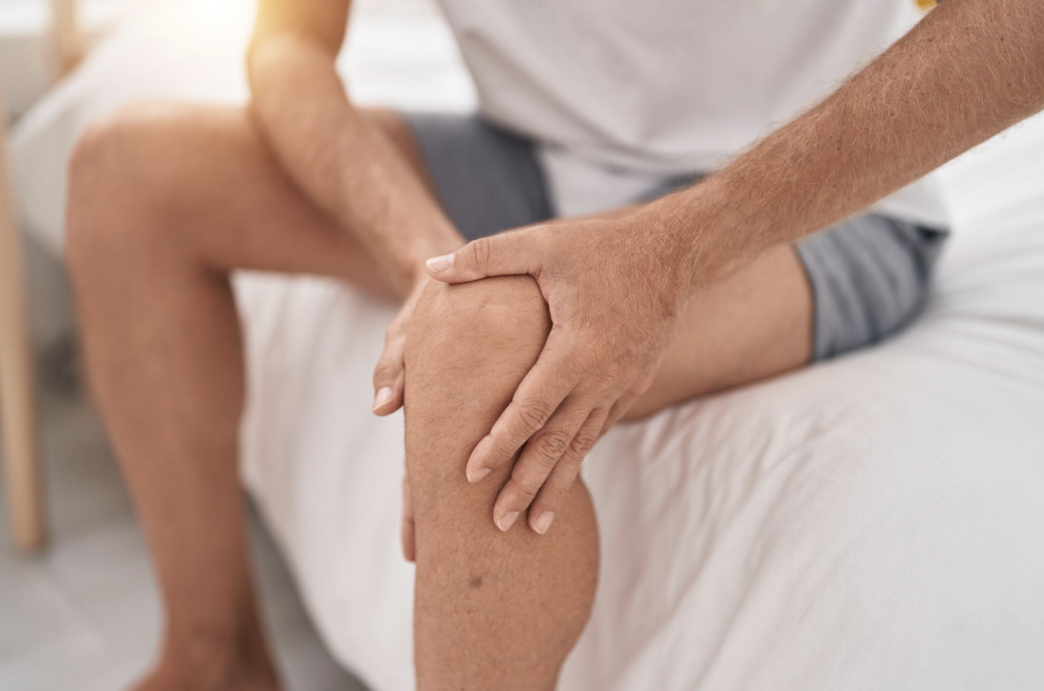
You sit down for a while.
Maybe you’ve been watching television, working at a desk, reading, or sitting through a long car ride.
Then you stand up.
And suddenly, your knees don’t seem to want to cooperate.
They feel stiff.
The first few steps may feel awkward or uncomfortable. You might need a moment before you can walk normally again.
Then something interesting happens.
After moving around for a few minutes, your knees start to feel better.
So what’s going on?
Why Sitting Can Make Your Knees Feel Stiff
Your joints aren’t designed to remain completely still for long periods.
When you’re sitting, your knees stay in a relatively fixed position. The surrounding muscles aren’t working as much, and you’re not moving the joint through its normal range of motion.
After you’ve been still for a while, that first movement can simply feel harder.
This is one reason you may experience what people often describe as “stiffness after rest.”
It doesn’t necessarily mean you’ve damaged your knee.
In many cases, your knee simply needs a little movement before it feels comfortable again.
Your Knees Are Designed to Move
A knee is a complex joint involving bones, cartilage, muscles, tendons and ligaments.
Normal movement helps these structures work together.
Your joints also contain a lubricating fluid that helps reduce friction and allows the joint surfaces to move smoothly.
When you remain still for a long time, you may notice more stiffness when movement begins again.
That’s why the first few steps after sitting can sometimes feel much worse than the next few.
Movement can gradually make the joint feel “looser.”
Age Can Make the Feeling More Noticeable
Occasional stiffness can happen at any age.
But it can become more common or noticeable as you get older.
Changes in cartilage, muscle strength, flexibility and joint health can all influence how your knees feel after periods of inactivity.
Previous injuries or conditions such as osteoarthritis can also contribute to stiffness.
This is why two people of the same age can experience very different knee symptoms.
The “First Few Steps” Can Tell You Something
Think about what happens when you get up after sitting.
Do your knees feel stiff for a few seconds?
Does it take several steps before you feel normal?
Do you need to straighten your legs slowly?
Does the stiffness disappear once you start moving?
These details can be useful.
Stiffness that is brief and improves with gentle movement is different from pain or stiffness that persists, repeatedly interferes with activity, or continues to worsen.
Long Periods of Sitting May Not Help
Modern life makes prolonged sitting surprisingly easy.
You can spend hours:
- Watching television
- Working at a computer
- Reading
- Driving
- Using a phone
- Sitting at a desk
- Traveling
Even if you exercise regularly, spending most of the day sitting means your joints and muscles may still spend long periods inactive.
One simple habit is to break up long periods of sitting.
Stand up.
Walk around the room.
Stretch gently.
Change position.
You don’t need to turn every break into a workout.
The goal is simply to give your body regular opportunities to move.
Your Muscles Matter Too
Sometimes the feeling in your knees isn’t entirely about the knee itself.
The muscles around your hips and thighs help support and control knee movement.
If these muscles become weaker or less conditioned, everyday activities can place greater demands on the knee.
Maintaining appropriate strength and mobility can therefore be an important part of supporting healthy movement.
If you have existing knee problems, however, exercises should be appropriate for your condition and ability.
When Knee Stiffness Deserves Attention
Not every stiff knee is a reason for concern.
But persistent or worsening symptoms shouldn’t automatically be dismissed as “just aging.”
Consider talking with a healthcare professional if you experience:
- Persistent or increasing knee pain
- Significant swelling
- Repeated episodes of the knee giving way
- Locking or an inability to fully move the knee
- Difficulty walking normally
- Stiffness that lasts for a prolonged period after getting up
- Symptoms following a significant injury
Sudden severe pain, major swelling, inability to bear weight, or an obvious deformity after an injury warrants prompt medical evaluation.
Stiffness vs. Pain: What’s the Difference?
It’s easy to use the words “stiff” and “painful” interchangeably, but they can describe different sensations.
Stiffness often feels like:
- Your knee is difficult to move at first
- Your leg feels tight or “rusty”
- The first few steps feel awkward
- Your range of motion feels temporarily reduced
- The feeling improves after gentle movement
Pain, on the other hand, may feel like:
- Aching, throbbing or soreness
- A sharp or stabbing sensation
- Burning or intense discomfort
- Pain that makes you change the way you walk
- Discomfort that persists even after you’ve started moving
You can experience both at the same time.
The important thing is to notice the pattern.
If your knees feel stiff for a short time after sitting and then gradually loosen up, that’s different from pain that repeatedly persists, becomes more intense, limits your movement, or is accompanied by swelling.
And if knee pain is severe, follows an injury, prevents you from bearing weight, or comes with significant swelling or a visibly deformed joint, seek medical evaluation rather than assuming it’s ordinary stiffness.
Stiffness is often a feeling of difficulty getting moving. Pain is a signal of discomfort. Knowing which one you’re experiencing—and noticing how it changes with movement—can help you decide when a simple change in your routine may be enough and when it’s worth getting professional advice.
A Simple Habit Worth Trying
If you know you’ve been sitting for a long time, don’t immediately spring to your feet and start walking quickly.
Before standing, gently move your ankles and straighten and bend your knees within a comfortable range.
Then stand slowly.
Take a few easy steps.
If your body feels stiff, give it a moment.
This isn’t about forcing the joint to “loosen up.”
It’s about allowing your muscles and joints to transition gradually from being still to moving again.
Pay Attention to What Happens After You Move!
Knee stiffness after sitting can be surprisingly easy to ignore.
You stand up.
You feel stiff.
You walk a little.
It gets better.
And you move on.
But your body’s response to movement is worth noticing.
If stiffness is brief and occasional, it may simply be your joints and muscles adjusting after inactivity.
If it becomes frequent, lasts longer, is accompanied by pain or swelling, or begins interfering with everyday activities, that’s a different story.
Don’t focus only on whether your knees hurt. Pay attention to how they behave.
How long does the stiffness last?
Does movement improve it?
Is it becoming more frequent?
Is it affecting the way you walk, climb stairs or get out of a chair?
Your knees don’t necessarily need more rest simply because they’re getting older.
Sometimes, they need regular, appropriate movement—and attention when something changes.